Your park needs care instructions that match its approved sock. Before bulk ordering, agree on the wash method, test production-equivalent samples, and record changes in grip, fit, and print. Then give guests a short care card and staff a clear reuse check.
Make the wash method part of the approved SKU
Ask your supplier for written instructions for each combination of yarn, grip material, print, and construction. A care rule for one style, especially a sock with a membrane or unusual finish, is not automatically valid for another.
| Field to approve | What to record | Why the park needs it |
| Wash | Hand or machine; temperature; cycle; inside-out or bag requirement | Gives both testing and guest instructions one consistent method |
| Chemicals | Permitted detergent; any restrictions on bleach or softener | Prevents the care card from contradicting the sample test |
| Dry | Flat, line, or permitted tumble setting | Drying is part of a full wash cycle, not an afterthought |
| Identity | SKU, size, color, grip design, revision, and care-card version | Keeps reorders tied to the tested product |
Obtain the wording in writing before artwork approval. If the supplier has not confirmed a setting, leave it off the pack. Do not turn a cautious trial setting into an unsupported claim that every trampoline sock tolerates it.
Run a repeatable wash trial before a bulk order
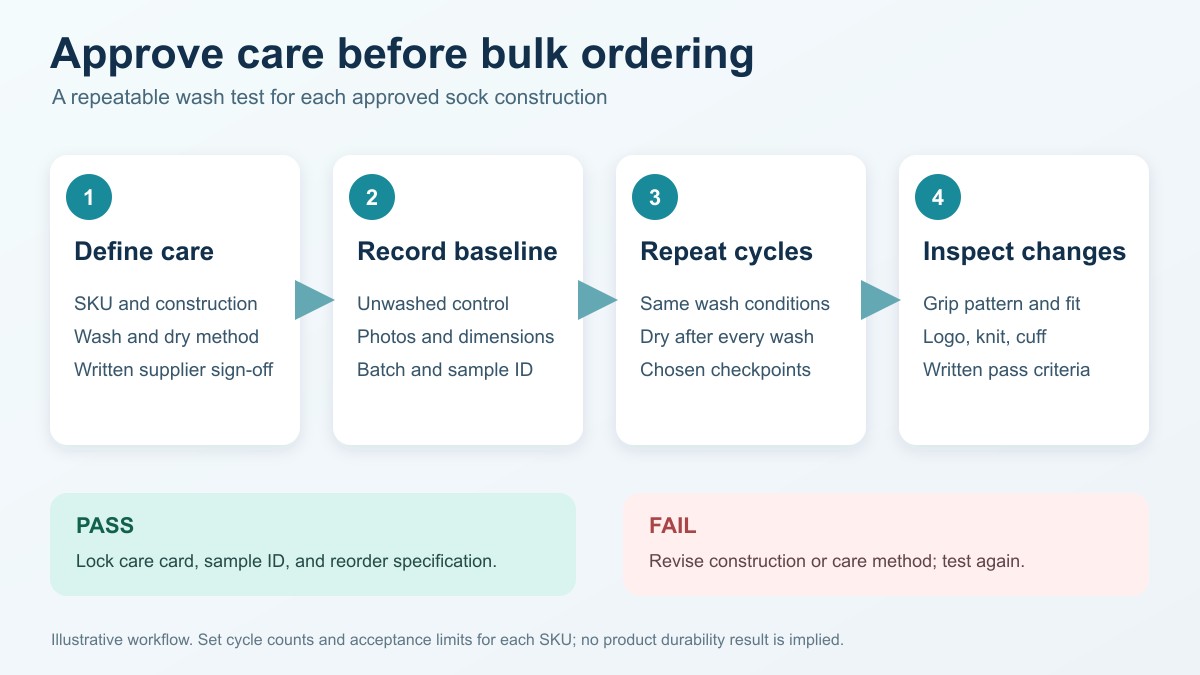
Keep one unwashed reference pair and at least two production-equivalent test pairs for each proposed construction. Test additional sizes or colors when their knit, print, or grip application differs. Label every pair so photos and measurements can be traced back to a sample.
- Photograph the sole, logo, cuff, toe, and heel under the same light. Record flat dimensions and the intended fit range.
- Choose the wash-and-dry method from the proposed care card. Keep machine, load, detergent, and drying method consistent.
- Set checkpoints before testing. For example, inspect at zero, five, and ten complete wash-and-dry cycles; use a different cycle count if your expected reuse pattern calls for it.
- Record each observation against the untouched reference. Note the batch, date, cycle count, and any change to the method.
Those checkpoint numbers are a practical pilot plan, not a durability certification or a claim that the sock survives ten washes. For a controlled lab request, ISO 6330 defines domestic washing and drying procedures for textile testing. Specify the actual procedure, not just the standard number.
Judge the sample against written pass criteria
Decide what counts as a failure before seeing the results. “Still looks fine” cannot tell your buyer whether the sole, fit, and printed park identity will meet the same specification on the next order.
| Check | Repeatable evidence | Decision to set in advance |
| Grip pattern | Same-angle sole photos; count missing, cracked, or lifting elements | Maximum permitted change, including whether any lifting is a rejection |
| Size and shape | Same flat measurement points before and after; recheck fit on the intended foot range | Permitted dimensional change and fit outcome |
| Logo and color | Same-light photos; check transfer to neighboring items and legibility | Accepted fade, transfer, and logo appearance |
| Knit and cuff | Inspect toe, heel, seams, holes, and cuff recovery | Defects that trigger rejection or resampling |
If dimensional change needs a formal report, ISO 5077 covers its determination after specified washing and drying. It does not establish grip adhesion or traction. Ask the supplier or lab to report those as separate, agreed checks; never invent a pass score after the test.
Turn the approved result into a guest care card
Give guests the approved method on the pack or receipt, and train the front desk to repeat it. A QR page can add detail, but the essential wash and dry directions should be visible without scanning.
Template: “Turn inside out. Wash using [approved method and temperature] with [approved detergent guidance]. Dry using [approved method]. Check that the grip is intact before your next visit.” Fill each bracket from the tested SKU record. Add a batch or revision code so old packs keep the correct instructions.
Avoid universal wording such as “never tumble dry” or “always use 30°C” unless it matches this sock’s approved care instruction. The park’s card must match the tested construction, including its drying method.
Set a return-visit check and complaint trail
Write one front-desk rule for guest-owned pairs. Staff should check that socks are dry, fit securely, and have intact grip coverage; they should apply the park’s own acceptance policy consistently. Washing a pair does not replace missing grip material or repair a loose sole print.
- At check-in: record the reason when a pair is declined, using simple categories such as poor fit, worn grip, or visible damage.
- For complaints: photograph the defect and capture SKU, batch, purchase date, and any known wash method or wash count.
- For reorders: compare complaints by batch with the approved sample and care-card revision before changing suppliers or specifications.
Do not promise that every washed pair will be admitted at another location; venues set their own sock rules. A consistent inspection record also gives your supplier a specific issue to investigate instead of a vague “the grips came off” report.
Add wash performance to the RFQ and reorder file
Include the approved care text, sample ID, test cycle schedule, observations, pass criteria, and any lab report in your purchasing file. Attach sole photos before and after washing. State whether production must match the tested yarn, grip compound, print method, and care card.
Put these fields beside sizes, colors, packaging, and cartons in your trampoline sock RFQ. Require written approval for material or process changes that affect care. An old wash test cannot validate a revised construction.
FAQs about Washing Trampoline Park Grip Socks
Should a park require a ten-wash test?
Choose a cycle target that reflects your expected reuse and procurement risk, then document it before sampling. Ten cycles in an in-house pilot are a proposed checkpoint, not a universal standard or certification.
Can we print “machine washable” on every grip sock?
Only when the approved construction has written machine-wash instructions and has been tested using those settings. If an alternate grip design or yarn changes the method, issue a new care-card revision.
Does a faded logo mean the grips have failed?
No. Record print appearance and grip condition separately. One may fail its agreed criterion while the other passes. Keep both checks in the sample record so the supplier can trace the actual problem.
Can washing restore a peeling grip?
No. Cleaning may remove surface dirt, but it cannot reattach missing or lifting grip material. Remove a visibly defective sample from approval and follow the park’s written rule for guest pairs.
Plan a Wash-Testable Sock Program With SinoKnit
We make custom socks for trampoline parks. When you plan a new trampoline sock range, send us your proposed care method and sample acceptance checklist. Contact us to discuss the construction and the instructions you need to approve before ordering.