Measure foot length the same way every time
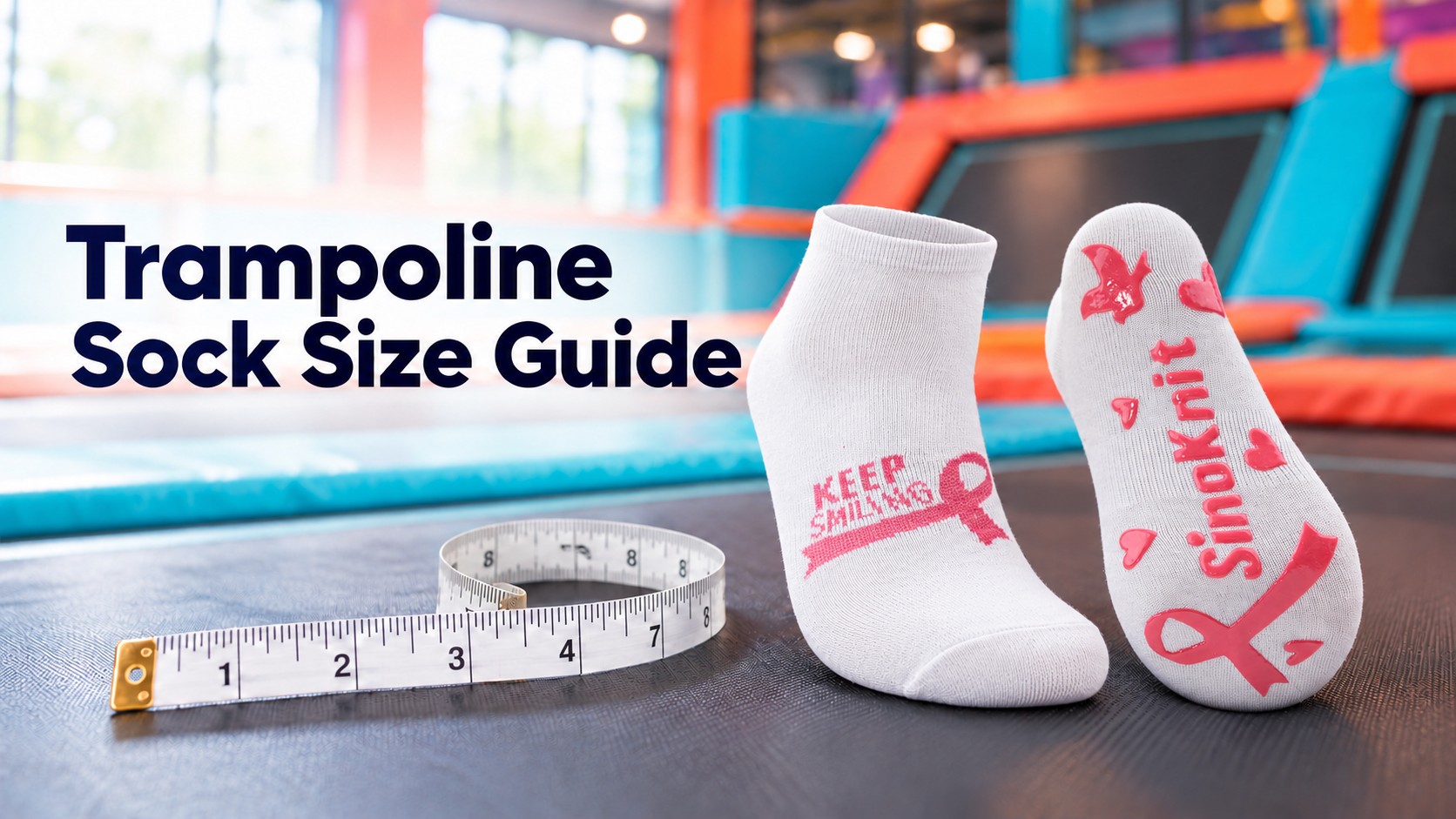
Start with heel-to-toe foot length in centimeters. Age is too rough for choosing a sock, and shoe-size conversions vary by market. Keep a sheet of paper, a pen, and a ruler available during sample fitting.
- Place the paper against a wall on a hard floor.
- Have the wearer stand with one heel lightly against the wall.
- Mark the longest toe and measure from the wall to the mark.
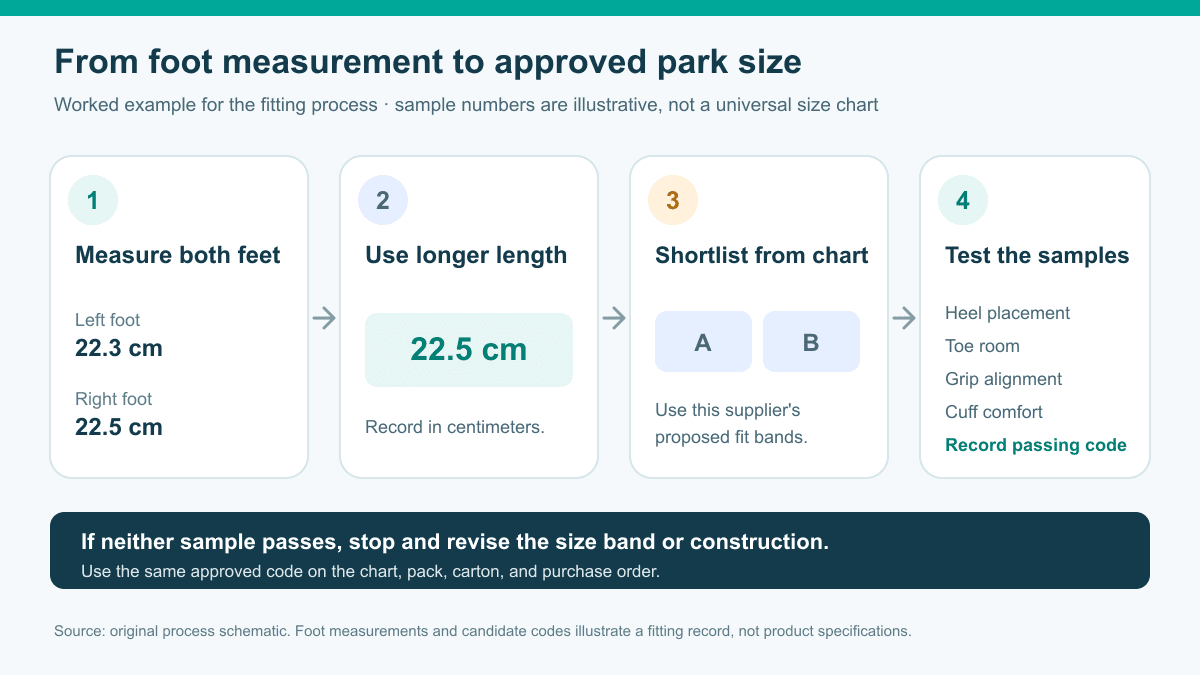
- Repeat on the other foot; use the longer measurement.
For example, if the left foot is 22.3 cm and the right is 22.5 cm, record 22.5 cm. Add the wearer’s usual shoe size only as a secondary reference. The centimeter measurement is what you compare with the supplier’s proposed fit range.
Turn the supplier’s chart into a working size card
Ask for the foot-length range of the exact sock you are buying. Confirm whether any other centimeter figure describes the wearer’s foot or the unstretched finished sock. The two measurements are not interchangeable.
| Field on your size card | What to enter | What it prevents |
| Park size code | A unique code such as C1, Y1, or A1 | Confusing a child S with an adult S |
| Approved foot-length band | Minimum and maximum in cm for this sock style | Guessing from an age label or another supplier’s chart |
| Sample ID | Code on the physical pair used in fitting | Approving one sample and receiving another construction |
| Pack identifier | Printed size, color cue, or barcode used at the desk | Staff translating between different labels |
| Revision date | Date the size band and sample were signed off | Reordering from an outdated chart |
Keep the approved chart beside the sample set. Put the same park code on the chart, pack, storage bin, carton, and purchase order. Shoe-size equivalents may help staff shortlist a pair, but only add them after checking the exact style.
Use a pass-or-fail fit check
Try the sample on a wearer whose foot length you recorded. Have them stand and take ten normal steps on an appropriate surface. Check the sock before and after the walk; a photo from above and below helps document any movement.
| Check | Pass | Fail: what to do next |
| Toes | Toes can lie flat; no fabric bunches at the front | Try the adjacent size or revise toe length |
| Heel | Heel pocket stays on the heel | Try another size; record lifting or pulling |
| Sole grip | Grip remains beneath the foot after walking | Reject a fit that rotates the grip toward the side |
| Cuff | Stays up without uncomfortable pressure | Review size or cuff construction |
| Overall feel | Wearer can move without pinching or excess slack | Record the exact complaint, not just “bad fit” |
This is a practical fit review, not a traction or injury-prevention certification. If any check fails, write down the foot length, sample ID, and failure. A supplier can act on “heel lifts on a 22.8 cm foot”; “size feels wrong” gives little direction.
Test the lower, middle, and upper edge of each band
A sample that fits one person at the center of a range has not validated both ends. For each proposed size, test at least one wearer near its minimum, midpoint, and maximum foot length. Five proposed sizes therefore need at least fifteen fitting observations.
Worked example, not a universal size chart: if a supplier proposes 20–23 cm, test wearers near 20.2, 21.5, and 22.8 cm. If the 22.8 cm wearer fails a heel or grip check, narrow the band or revise the sock before printing it.
Use the same yarn, cuff, sock height, and grip pattern intended for production. A fit approval for one construction should not automatically carry over to another. Keep one signed sample per size so your team can compare later deliveries.
Handle overlaps and gaps without guessing
Neighboring size bands can overlap. In an illustrative supplier chart, size A covers 20–23 cm and size B covers 22–25 cm. A 22.5 cm foot appears in both. Test A and B; choose the sample whose heel, toe, cuff, and sole grip pass.
A gap needs a different response. If A ends at 22 cm and B begins at 23 cm, a 22.5 cm foot has no approved band. Do not force a label onto the chart. Ask for a revised size range or another sample, then test it.
Make the chart work at the front desk and warehouse
At check-in, ask for the usual shoe size, shortlist a park code, and offer that sample. If the guest is near a boundary or the heel/grip looks misplaced, measure the foot and try the adjacent size. If neither passes, record the case instead of forcing a fit.
Keep a small issue log with four columns: measured foot length, samples tried, size issued, and reason for any switch. Review repeated switches before the next purchase order. They show where a printed size band may be too wide or a label may be confusing.
Write each purchase-order line with the sock style, park code, approved foot-length band, sample revision, color, pack label, and pair quantity. Confirm whether cartons are single-size or mixed-size. At receiving, compare each carton label and a sample pair with the approved record.
Use actual pairs issued, rather than visitor count, to plan how many of each approved size to buy; returning guests may bring their socks back. The order-quantity guide covers size-mix and reorder calculations.
FAQs about Trampoline Park Sock Sizes
Can I use age groups instead of foot length?
Use age only to organize a starting range. Measure feet during sample approval, then print the approved centimeter bands. Two children in the same age group may need different pairs.
Should guests always size up between two sizes?
No. Try both samples. A larger sock may twist and move the sole grip; a smaller one may crowd the toes. Choose by the recorded fit checks rather than a blanket rule.
When should I redo the size test?
Repeat it when the supplier changes the yarn, cuff, sock height, grip layout, or grading; also review it when staff repeatedly switch guests between neighboring sizes. Keep the new chart revision with its approved samples.
Plan your size run with SinoKnit
We manufacture trampoline socks for parks. Send us your guest foot-length range, preferred style, and fit-test notes so we can discuss suitable samples and a clear size specification. Contact us when you are ready to plan an order.