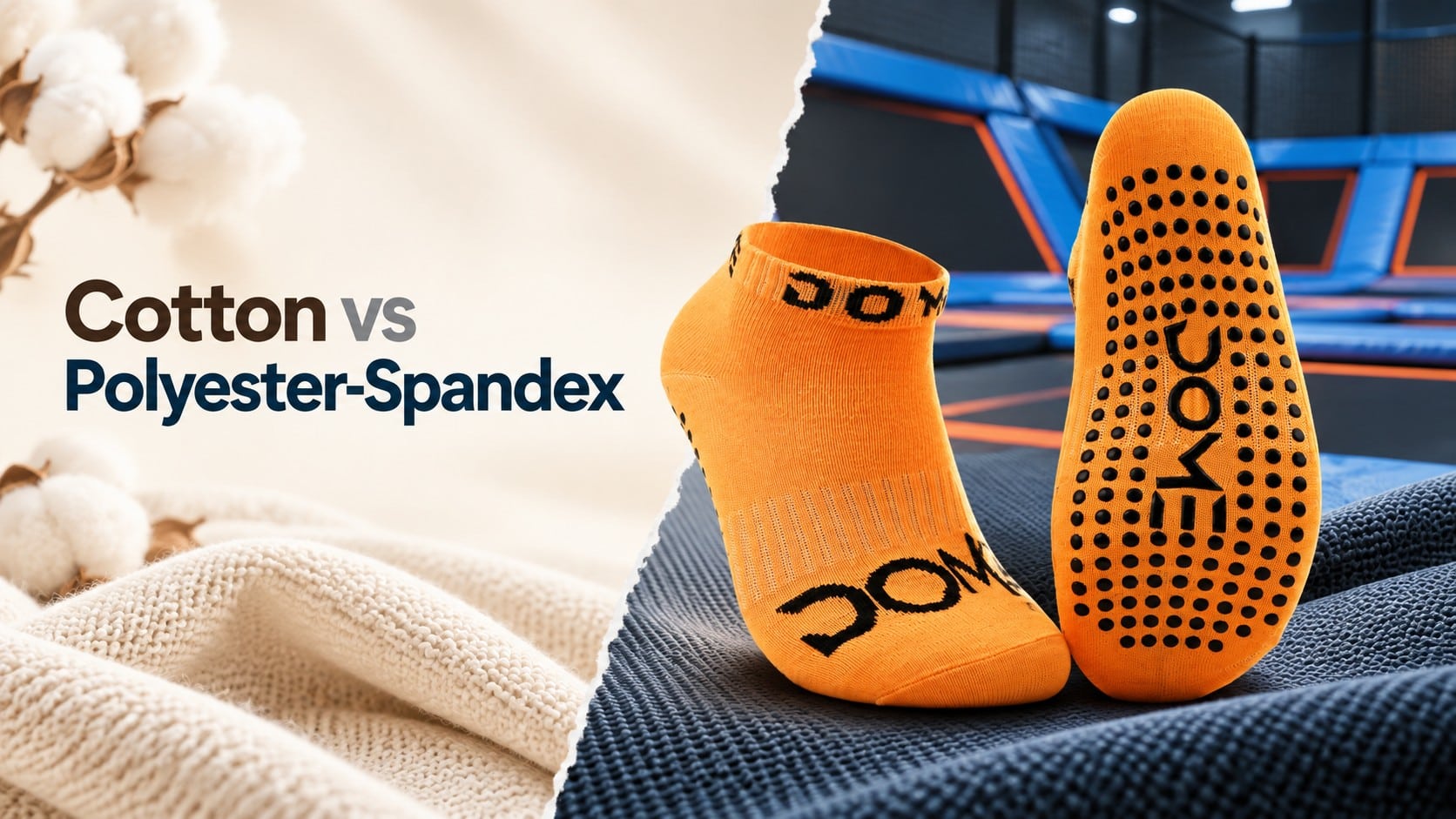
For trampoline parks, the best sock material depends on throughput, drying, fit retention, guest comfort, and your ordering model. Compare the full blend—not just the headline fiber—before approving a sample.
Why material choice matters in a trampoline park
A park sock has a different job from a casual everyday sock. It sits inside a high-traffic operation where guests move, sweat, jump, queue, wash, and sometimes reuse the same product.
The fabric body affects softness, moisture handling, shape retention, and perceived value. The sole grip affects traction. These are connected decisions, but they should be specified and tested separately.
SinoKnit’s custom sock process lists cotton, nylon, acrylic, wool, polyester, and other materials, along with custom colors, samples, and an anti-slip bottom process. That means a park can request a material brief instead of accepting a generic recipe.
Cotton, polyester, and spandex do different jobs
| Fiber | What it can contribute | What a park should verify |
| Cotton | Soft hand feel, familiar comfort, and a natural absorbent character. | Drying behavior, shape retention, abrasion at heel/toe, and performance after repeated laundering. |
| Polyester | Low moisture absorption, quick recovery, color options, and useful durability for active use. | Actual knit construction, surface feel, odor management, and whether any wicking claim is tested. |
| Spandex / elastane | Stretch and elastic recovery that help the sock stay in place across a size range. | Blend percentage, cuff construction, fit after washing, and whether the sock twists or loosens. |
Cotton absorbs moisture into the fiber, while polyester is generally used to move less moisture through the fiber system and dry more readily. The real result still depends on yarn, knit density, finishing, climate, and laundering.
For a technical comparison, ask whether your supplier can document moisture-management testing. Textile test methods evaluate the fabric structure and wicking behavior together, rather than assuming a result from fiber names alone.
When a polyester-spandex blend is the practical starting point
Polyester-spandex is often a sensible starting point for a busy park that prioritizes consistent sizing, fast handling, and a controlled cost per pair.
- High guest turnover: A synthetic-rich knit can recover its shape quickly between sessions and reduce the risk of a loose fit.
- Short drying windows: Faster-drying behavior can simplify storage and replenishment when socks are washed or handled frequently.
- Broad color programs: Polyester is commonly chosen when a park needs bright, repeatable colors for brand identity or size coding.
- Value-focused programs: A lightweight synthetic blend can support a sell-once or high-volume model, subject to sample and cost validation.
One current SinoKnit product page lists a 96% polyester and 4% spandex blend for a custom ankle grip sock. Treat that as a SKU-level example, not a universal formula for every park.
Ask for the exact blend, yarn construction, size range, grip material, packaging, and current MOQ on the quotation. Product-page specifications can differ by SKU and application.
When a cotton-rich blend deserves consideration
Cotton-rich socks can make sense when comfort, softness, and a more premium guest experience matter more than the lowest possible unit cost.
- Longer guest wear: Families may keep branded socks after a visit, so hand feel and comfort can influence perceived value.
- Premium positioning: A softer fabric story can support a higher-quality merchandise program when the branding and packaging match it.
- Comfort-sensitive audiences: Cotton can feel familiar against skin, but the final fit and drying behavior must still be tested.
- Mixed-use products: If the same sock will be worn at the park and at home, a comfort-led blend may be more appealing.
Do not assume that “cotton” automatically means better breathability or that “polyester” automatically means better moisture management. A loose, dense, treated, or poorly fitted knit can change the experience.
How to choose a blend for your park program
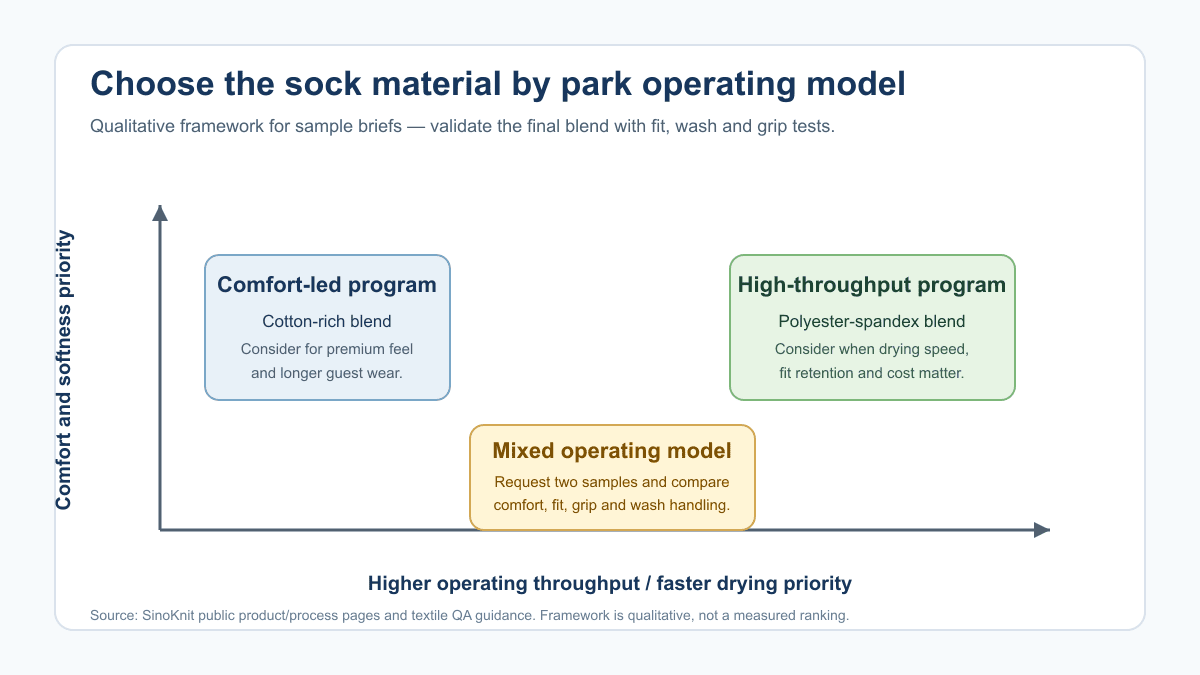
Start with the operating decision, not a preferred fiber. Write down how guests receive, use, store, wash, sell, and reorder the socks.
| Park question | What to specify | Evidence to request |
| Is the sock sold once or reused? | Operating model, expected handling, and care process. | Sample results after your planned wash and handling routine. |
| Who must fit the sock? | Children, youth, adult, or a mixed size run. | Size chart, stretch recovery, cuff security, and fit samples. |
| What matters at the gate? | Color coding, visible logo, packaging, or size labels. | Artwork mockup, packaging sample, and sorted-carton example. |
| What does the sole need to do? | Grip material, coverage, logo pattern, and target surfaces. | Grip sample and a documented inspection method. |
| What is the reorder risk? | Approved blend, yarn, colors, sizes, packaging, and version number. | Locked specification and repeat-order confirmation. |
For mixed requirements, request two prototypes: one polyester-spandex option and one cotton-rich option. Compare the same sock height, cuff, grip pattern, and packaging so the fabric—not the design—drives the decision.
What to include in a supplier sample review
- Fit: Check the smallest and largest intended sizes on real wearers. Note slippage, twisting, pressure, and recovery after removal.
- Comfort: Review seam placement, fabric hand feel, toe room, heat, and wet feel after an active session.
- Grip: Inspect sole coverage, pattern consistency, logo clarity, and compatibility with your park’s surfaces.
- Handling: Run the planned wash or cleaning process, then document appearance, stretch, grip, and packaging condition.
- Commercial fit: Confirm blend, size run, colors, MOQ, lead time, packing, QC, and repeat-order references on the quote.
Keep the approved sample and specification together. A material decision is only useful when the supplier can reproduce the same blend, construction, colors, grip, and packaging on the next order.
FAQs about Cotton vs Polyester-Spandex for Trampoline Park Socks
Is polyester-spandex better than cotton for trampoline parks?
Not universally. Polyester-spandex is often practical for high-throughput, fast-handling programs, while cotton-rich blends may suit comfort-led or premium merchandise programs. Test the finished sock.
What does spandex add to a trampoline park sock?
Spandex, also called elastane, adds stretch and recovery. The right result depends on the percentage, cuff, knit construction, and size range—not the fiber name alone.
Does a cotton blend make the grip better?
No. Grip performance comes primarily from the sole material, pattern, coverage, application quality, and target surface. Fabric choice affects fit and comfort around that grip system.
Should a park use one material for every size?
Often it is easier to manage one approved specification, but children’s and adult sizes can behave differently. Validate the smallest and largest sizes before locking the program.
What should I ask a trampoline sock supplier?
Ask for the exact fiber blend, size chart, grip specification, sample process, packaging, MOQ by design/color/size, QC method, lead time, and repeat-order controls.
Need help selecting a material?
We make custom trampoline socks with configurable materials, colors, sizes, logos, grip patterns, packaging, sampling, and OEM/ODM support. Review the trampoline socks wholesale range, then contact us with your park’s visitor mix, operating model, and sample requirements.