Packaging affects how quickly staff receive socks, identify sizes, refill the front desk, and present a branded product. For trampoline parks, the right format should support daily operations first, then retail and marketing goals.
Why packaging is an operational decision
A trampoline park may issue or sell hundreds of sock pairs across a busy weekend. If every pair arrives in a different format, staff spend time opening cartons, sorting sizes, and answering avoidable questions. A packaging brief should therefore start with the path from factory to guest.
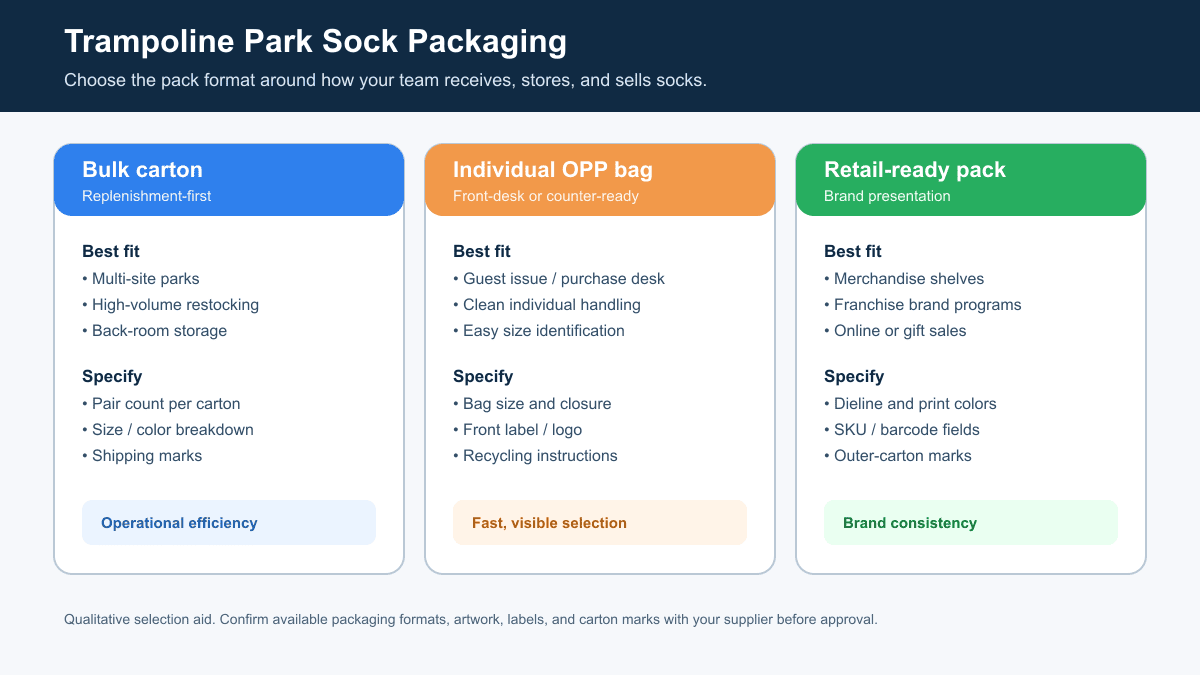
Three packaging formats for park sock programs
| Format | Best use | Advantages | Confirm before approval |
| Bulk carton | High-volume replenishment and multi-site storage | Efficient receiving, fewer handling steps, clear outer marks | Pairs per carton, size/color mix, carton dimensions, shipping marks |
| Individual OPP bag | Front-desk issue, clean handover, or counter sales | Protects each pair, makes size and logo visible, easy to count | Bag size, closure, label position, recycling message |
| Retail-ready pack | Merchandise shelves, franchise programs, or online orders | Stronger brand presentation and space for product information | Dieline, print colors, SKU fields, barcode requirements, master carton plan |
Build labels around fast size identification
Guests rarely know a sock style name. They ask for a size, a color, or “the same pair as last time.” Make those choices visible without opening the pack. Put the size range, color name or code, and a simple product description in a consistent location.
For a multi-site program, agree on a size vocabulary before sampling. Decide whether the pack will show age bands, shoe-size ranges, or both. Keep the same order and typography on every colorway. This reduces picking errors when different teams receive the same SKU.
Barcode and SKU fields may be useful for retail or warehouse systems, but they should be confirmed in the supplier brief rather than assumed. Ask which barcode format, quiet zone, label material, and scan surface your system needs. Include a physical scan test in sample approval.
Make cartons work for receiving and replenishment
Outer cartons are operational documents as much as shipping containers. A useful carton mark can show the style, color, size breakdown, pair count, purchase-order reference, destination site, and carton sequence. Keep the information readable from a pallet or shelving aisle.
SinoKnit’s public business process describes customized packaging, OPP bags, cartons, and shipping marks as part of the order workflow. Treat those items as a starting point for your specification. Confirm the exact pack-out, carton strength, dimensions, and marks for your shipment.
If several parks share one purchase order, consider separate carton marks per site or a site code on the packing list. That small decision can prevent a central warehouse from opening every carton to redistribute inventory.
Write a packaging brief your supplier can quote
A vague request such as “custom packaging with our logo” creates delays because the supplier still has to guess the channel and pack-out. Send a one-page brief with the following fields:
- Sales route: guest issue, front-desk sale, merchandise shelf, online order, or a mix.
- Pack hierarchy: pair pack, inner pack, master carton, and any site-level grouping.
- Product data: style name, size range, color codes, composition statement, care text, and origin text as required.
- Brand assets: logo files, colors, artwork dimensions, dieline, and approved wording.
- Logistics: destination, carton marks, shipping-mark language, and preferred packing-list fields.
- Approval rules: artwork proof, packaging sample, sock sample, scan test, and sign-off owner.
Approve the sample before bulk production
Review the package with the people who will use it. A buyer can approve the artwork while a front-desk supervisor notices that the size is hidden or the bag tears during opening. A short test catches those practical issues before they are multiplied across a bulk order.
- Check that the sock pair fits the package without being compressed or distorted.
- Confirm the size, color, logo, care, and origin information against the approved brief.
- Open and close several samples with the gloves or tools staff normally use.
- Stack cartons as they will be stored and inspect marks from a normal viewing distance.
- Scan any barcode on multiple surfaces and test the handover process at the desk.
- Photograph the approved pack-out and attach it to the purchase-order record.
SinoKnit’s process also places artwork, materials, technology, samples, quotation, production, quality control, and shipping in sequence. Align packaging approval with the sock sample instead of treating it as a last-minute print job.
Ask suppliers to quote the sock and packaging as one defined configuration. Clarify whether artwork support, sample fees, packaging components, carton marks, and packing-list details are included. Request a written description of what changes trigger a new sample or a new packaging cost.
FAQs about Trampoline Park Sock Packaging
Should every pair be individually packaged?
No. Individual packaging is useful for front-desk handover or retail presentation. High-volume replenishment can use a carton-led format, or individual bags inside a master carton. Choose based on handling, hygiene expectations, and sales channel.
Are OPP bags and cartons suitable for the same order?
Yes, they can serve different levels of the pack hierarchy. Confirm the inner quantity, carton dimensions, and shipping marks so the supplier packs the approved number of pairs per carton.
Do trampoline park socks need a barcode?
Only if your retail, warehouse, or point-of-sale process needs one. Define the barcode owner, number format, label placement, and scan test in the brief. Do not approve artwork until the code is verified.
What should be printed on a carton mark?
Start with the purchase-order reference, style, color, size breakdown, pair count, carton sequence, destination, and any handling language required by your forwarder. Your supplier can confirm the final mark layout.
How do I start a custom packaging request?
Share your sock specifications, artwork, target quantity, packaging route, destination, and sample requirements. You can review the trampoline sock range, then send the complete brief through the contact page.
Turn packaging into a repeatable park system
The best trampoline park sock package is not simply the most colorful or premium-looking option. It is the format that lets your team receive, identify, store, issue, sell, and reorder with fewer decisions. Define the workflow, approve the pack-out with real staff, and lock the specification for repeat orders.
For a custom program, discuss colors, sizes, logos, grip patterns, and packaging together. Review the manufacturing process and ask for a sample that shows the complete sock-and-package combination before you release bulk production.
Source note: Operational references are based on SinoKnit’s public business-process and product-category pages. Packaging formats, labels, and carton marks must be confirmed for the specific order and destination.